
Abuja, Nigeria —
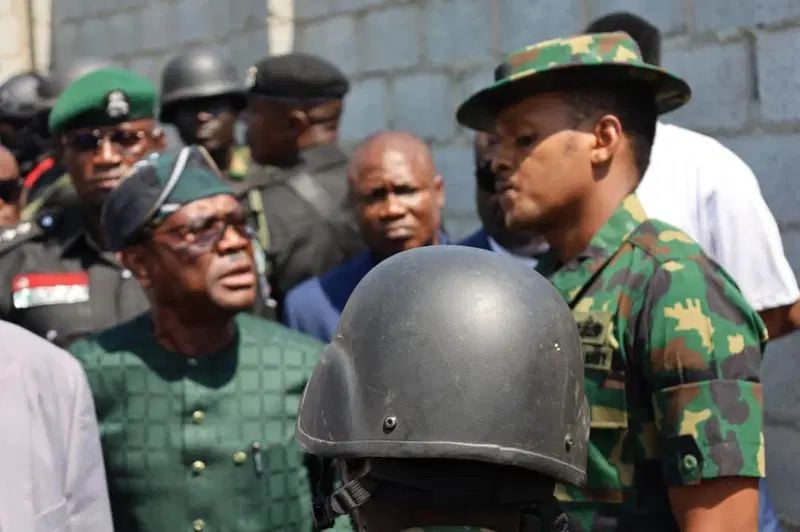
A heated confrontation between the Minister of the Federal Capital Territory (FCT), Nyesom Wike, and a naval officer, Lieutenant A. Yerima, has drawn sharp criticism from retired military generals and legal experts, who warn that the incident undermines respect for the chain of command and the sanctity of Nigeria’s security institutions.
The clash, which occurred on Tuesday over a disputed plot of land in Abuja’s Mabushi district, was captured in a viral video showing Wike berating the officer, who was reportedly guarding the site on the orders of a former Chief of Naval Staff, Vice Admiral Zubairu Gambo (retd.).
In response to the widespread outrage, Minister of Defence Mohammed Badaru announced that an investigation was underway. Speaking during a press briefing to mark the 2026 Armed Forces Remembrance Day at the National Defence College, Abuja, Badaru commended Lieutenant Yerima’s restraint during the altercation and vowed to protect military personnel performing lawful duties.
“We will always protect our officers on lawful duty,” Badaru said. “Any officer carrying out his assignment within the law will be fully protected. We won’t allow intimidation of our personnel who are doing their job diligently.”
The altercation reportedly stemmed from a dispute over land allegedly taken over by the former naval chief. Wike accused Gambo of illegal acquisition, while military sources said the officers were securing the property on official instructions.
Former Chief of Army Staff, Lt. Gen. Tukur Buratai (retd.), condemned Wike’s conduct, describing it as “a dangerous display of indiscipline.”
“A minister’s verbal assault on a uniformed officer is an affront to the Commander-in-Chief and undermines military morale,” Buratai wrote on Facebook. “Such behavior strikes at the foundation of our national security structure.”
Other veterans, including Brig. Gen. Peter Aro (retd.) and Brig. Gen. Bashir Adewinbi (retd.), echoed similar concerns. Aro said the confrontation highlighted the need for civilian officials to exercise restraint in a democracy.
“The officer was acting under lawful orders from his superior,” Aro noted. “Wike had every right to question land ownership, but through proper channels not public confrontation.”
Adewinbi described the incident as “unacceptable,” warning that such behavior toward uniformed officers “reflects poorly on the government and erodes institutional respect.”
However, Wike’s aide, Lere Olayinka, defended his principal, insisting the confrontation was the result of a fraudulent land deal.
Appearing on Channels Television’s Sunrise Daily, Olayinka explained that the disputed property was originally designated for park and recreation purposes in 2007 and could not legally be developed for residential use.
“The company that got the allocation sold the land illegally to private individuals, including the former Chief of Naval Staff,” he said. “Vice Admiral Gambo was misled into buying land that was never meant for private construction.”
He added that Gambo had no valid title documents or approved building plan for the site, stressing that the land remains under government control.
But constitutional lawyer and Senior Advocate of Nigeria, Prof. Sebastine Hon, faulted the naval officer for obstructing the minister, arguing that Yerima’s action amounted to a breach of law.
“The officer cannot justify blocking a minister representing the President in the FCT,” Hon said. “Even the Supreme Court has ruled that military personnel are not bound to obey illegal orders.”
Citing sections 297(2) and 302 of the 1999 Constitution, Hon maintained that Wike legally exercises the President’s powers over FCT land administration and acted within his authority.
Still, another Senior Advocate, Simon Lough, cautioned that while Wike’s authority is constitutionally valid, his approach was questionable.
“As the President’s representative in the FCT, Wike has power over land matters,” Lough said. “However, his personal presence at the site was unnecessary and undermined the dignity of his office.”
Human rights lawyer Pelumi Olajengbesi disagreed with Wike’s conduct, insisting the minister overstepped his bounds.
“No minister has authority to issue commands to a soldier on duty,” Olajengbesi stated. “Such actions risk blurring the lines between civil authority and military command.”
He warned that if left unchecked, the confrontation could embolden future clashes between political figures and security personnel.
As public debate rages, analysts say the episode underscores long-standing tensions between civil and military institutions in Nigeria and the urgent need for clearer boundaries between executive authority and armed discipline.