
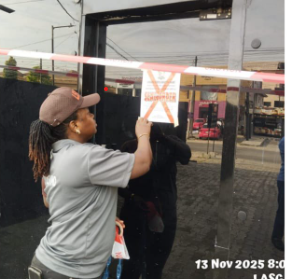
Lagos, Nigeria —
The Lagos State Government has sealed Ejanla Restaurant, located at No. 40, Fola Osibo Street, Lekki, for allegedly discharging raw sewage into public drains, in violation of environmental regulations.
Commissioner for Environment and Water Resources, Tokunbo Wahab, announced the development on Thursday in a post on X, stating that the Lagos State Wastewater Management Office (LSWMO) carried out the enforcement after discovering that the restaurant was using a pumping machine to channel untreated sewage directly into public drains.
“The Lagos State Wastewater Management Office (LSWMO), on Thursday, 13th November 2025, sealed off Ejanla Restaurant at No. 40, Fola Osibo Street, Lekki, Lagos for deliberate discharge of raw sewage into the public drains via a pumping machine, causing offensive odour in the community, constituting public nuisance, environmental pollution and endangering human life,” Wahab said.
He warned that such infractions would not be tolerated, stressing that the state would continue to clamp down on individuals and businesses that endanger public health.
“Every act of environmental nuisance and pollution portends grave dangers to public health and will be met with appropriate sanctions and prosecution,” he added.
The sealing of Ejanla Restaurant forms part of a broader enforcement campaign by Lagos authorities targeting commercial establishments that violate environmental standards.
In recent years, several restaurants, hotels, and industrial facilities have been sanctioned for similar offences, including the illegal discharge of wastewater into public drains—an act that contributes to flooding, offensive odours, and the spread of waterborne diseases.
In October 2025, PUNCH Online reported that the government sealed a branch of Chicken Republic at No. 23, Agungi Ajiran Road, Lekki, for deliberately releasing wastewater into the public drainage system. Similarly, in September 2024, another fast-food outlet, Cravings & More, located on Egbeda-Idimu Road, was shut down for discharging fats and oils into drains, resulting in foul odour and pest infestation.
Lagos, Nigeria’s commercial capital, continues to face major challenges with waste management and urban sanitation, as population growth and unregulated construction strain existing infrastructure.
Public drains in many areas are frequently clogged or misused, heightening risks of flooding, pollution, and outbreaks of diseases such as cholera and typhoid.
The Lagos State Wastewater Management Office, under the Ministry of the Environment and Water Resources, is tasked with regulating wastewater disposal across the state, inspecting facilities for compliance, and prosecuting violators.
Officials have repeatedly appealed to property owners, hoteliers, and restaurateurs to adopt proper sewage disposal systems, warning that the state will not hesitate to impose penalties on offenders who compromise public safety.