
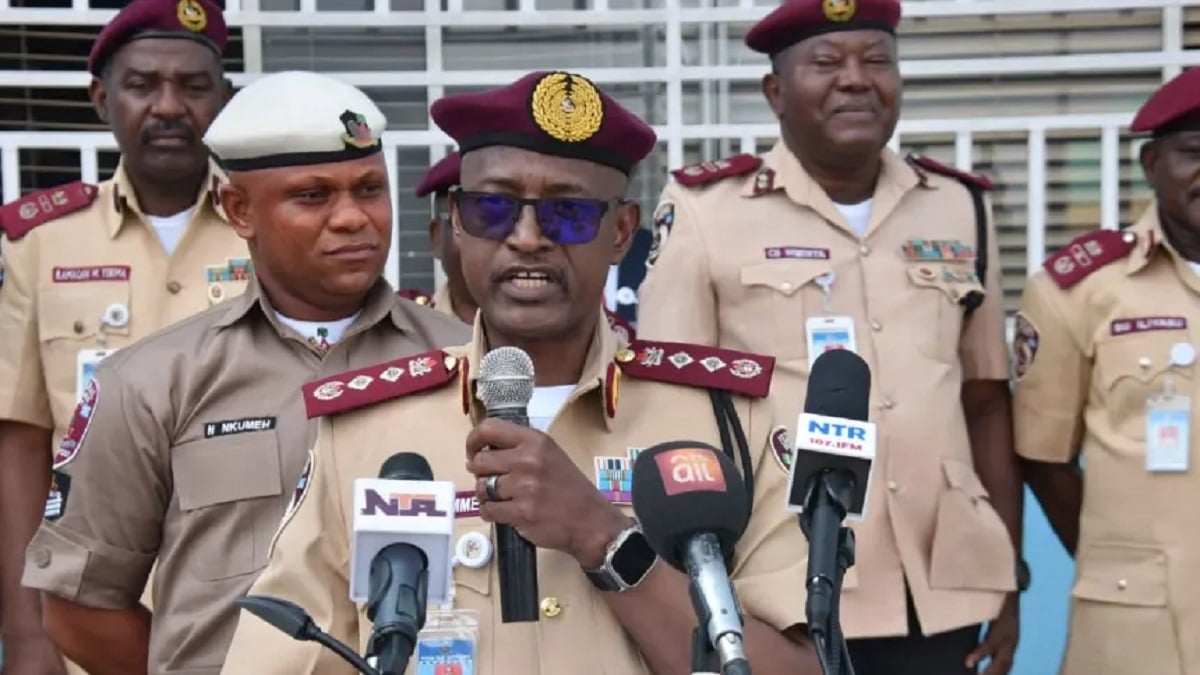
The Federal Road Safety Corps (FRSC) has announced the introduction of a contactless biometric capture system for driver’s licence issuance, marking a major milestone in Nigeria’s journey toward digitalised motor vehicle administration.
The innovation was unveiled on Monday in Abuja during the flag-off of the 2025 Ember Months Road Safety Campaign, themed “Tech Responsibility for Your Safety: Stop Distracted Driving.”
The annual campaign aims to curb the surge in road crashes often recorded between December 15 and January 15, a period known for heavy traffic, festive travel, and increased road accidents.
Eliminating delays and temporary licences
Speaking at the launch, Corps Marshal Shehu Mohammed said the new system would eliminate delays and end the era of temporary driver’s licences.
“We have activated plans to overcome the perennial challenges associated with delays in obtaining driver’s licences and number plates. Our printing facility has been upgraded to produce an average of 15,000 licences daily,” Mohammed stated.
He added that the production capacity would be increased further to clear the existing backlog before the second week of November 2025.
“The FRSC is about to commence contactless biometric capture with on-spot printing of licences, which will eliminate temporary documents and mark the start of a fully digital one-stop-shop for processing driver’s licences,” he said.
According to the Corps Marshal, the system was developed in collaboration with key stakeholders, including state governments, in recognition of the concurrent nature of licensing under Nigeria’s constitution.
Fully digital, seamless, and integrated
Mohammed explained that the new contactless biometric capture technology would allow applicants to obtain their driver’s licence instantly after biometric verification.
“Once you reach the point of capture, you get captured and you get your driver’s licence instantly. There’s no longer going to be a temporary licence or long waiting periods,” he assured.
The process integrates data from the National Identification Number (NIN) system for seamless identity verification, ensuring uniformity and security across all FRSC databases.
“It is no longer going to be the process of placing fingers on the scanner. This one is contactless. It doesn’t take time and captures all essential biometric data accurately,” Mohammed explained.
He added that the system would also synchronise with the operations of the Vehicle Inspection Office (VIO) and accredited driving schools for faster, centralised processing.
During a media tour of the FRSC’s Driver’s Licence Print Farm, Deputy Corps Marshal for Motor Vehicle Administration, Aliyu Datsama, revealed that the new system is already operational and will be rolled out nationwide, including Lagos and other major cities.
Datsama disclosed that the corps had been managing a backlog of 800,000 unprocessed driver’s licences, which has now been reduced to 400,000.
“We are now working 24/7 to clear the remaining backlog. Our current daily production capacity stands at 40,000 licences, and by the grace of God, we will clear everything in the next few weeks,” he said.
He further urged motorists who have completed biometric capture to visit their licensing centres to collect their cards, noting that over 206,000 licences remain unclaimed across various states.
The FRSC’s latest move aligns with Nigeria’s broader push for digital governance and improved service delivery. The contactless system is expected to not only streamline licence processing but also strengthen road user data management and accountability.
Meanwhile, the 2025 Ember Months Campaign will intensify public sensitisation on the dangers of distracted driving, particularly the use of mobile phones while behind the wheel.
Mohammed emphasised that the corps remains committed to leveraging technology to reduce road crashes and improve road safety nationwide.
“This new initiative is about responsibility responsibility in technology use, responsibility in driving, and responsibility in ensuring that every journey counts,” he concluded.