
ABUJA, Nigeria
The Nigerian Meteorological Agency (NiMet) has issued a flood alert for July, warning that at least 21 states—including Sokoto, Lagos, Edo, and Benue—are at significant risk of flash flooding due to the intensifying rainy season.
In its monthly forecast released Monday, NiMet identified Sokoto as facing the highest risk. Other states flagged include Kaduna, Zamfara, Yobe, Bauchi, Bayelsa, Jigawa, Adamawa, Taraba, Niger, Nasarawa, Ogun, Ondo, Delta, Cross River, Rivers, and Akwa Ibom. The agency advised residents in flood-prone areas to take precautionary measures, including clearing drainage systems, preparing emergency kits, and relocating from vulnerable zones when necessary.
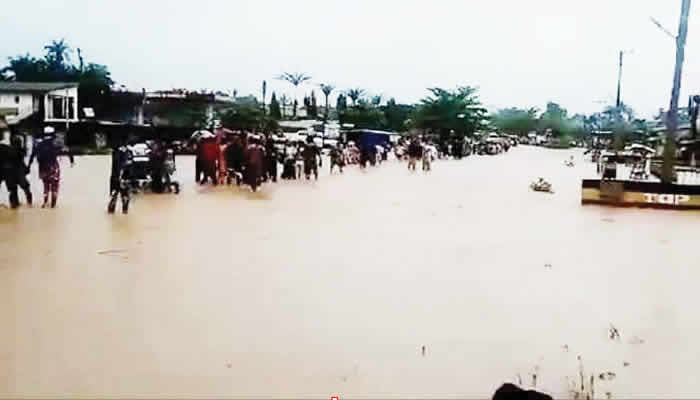
The alert comes as flood-ravaged communities, particularly in Ondo State, plead for urgent government intervention following weekend downpours that destroyed property worth millions of naira. Areas in Owo, Okitipupa, Ilaje, and Ese-Odo Local Government Areas were worst hit, with submerged bridges and collapsed buildings reported in communities such as Uso, Ayeka, Ikoya, Igbodigo, Igodan, and Igbotako.
“The flooding was caused by erosion from Igodan and an overflowing stream during the heavy downpour,” said Joshua Jemiloni, a resident of Okitipupa, whose property was among at least 10 buildings affected. Local officials and community leaders have urged both state and federal governments to respond quickly to the crisis.
Ondo State Governor Lucky Aiyedatiwa said the state has begun dredging waterways to reduce the effects of flooding and natural disasters. “We shall continue with initiatives to reduce the effects of floods and enforce environmental sanitation laws,” he stated.
Spotlight on Ecological Fund Mismanagement
The recent floods have reignited scrutiny over the use of Nigeria’s Ecological Fund, which has disbursed over ₦622 billion to the 36 states from 2012 to early 2025. Despite the enormous funding, many states remain critically underprepared for recurring flood disasters.
Environmental groups, climate researchers, and urban planners have strongly criticized state and federal authorities, citing poor implementation, lack of transparency, and suspected mismanagement.
“This situation happens year after year. Billions are disbursed, yet communities remain vulnerable,” said Afolabi Abiodun, President of the Africa Environmental Health Organisation. “We don’t see the impact. Where is the accountability?”
The Ecological Fund, established in 1981 and financed with 2% of the Federation Account, is meant to support interventions for erosion, desertification, oil spills, drought, and flooding. It is managed by the Ecological Fund Office under the Secretary to the Government of the Federation (SGF). However, critics say the fund’s objectives are being undermined by inefficiency and corruption.
Findings by The PUNCH revealed that between 2017 and 2022, over ₦300 billion was allocated to states, while ₦39.62 billion was disbursed from June 2023 to June 2024. In January 2025 alone, Kano received the highest allocation of ₦2.5 billion, followed by Lagos (₦2.1 billion), Borno (₦1.97 billion), and Niger (₦1.8 billion).
Yet in Niger State, floods recently devastated Mokwa town, prompting a spike in the death toll. “It’s been 60 years since we saw flooding this bad,” said district head Muhammad Shaba Aliyu, calling for immediate government support.
A Nationwide Crisis
According to a June 2025 report by SBM Intelligence, floods have affected 1.2 million people across 31 states since July 2024. The report notes that approximately 180,000 hectares of farmland have been destroyed, exacerbating food insecurity and inflation—already at 35.41% as of January 2024.
A separate report by StatiSense recorded that in May 2025 alone, flooding affected 116,711 people in 12 states. Zamfara topped the list with 58,386 victims, followed by Kwara (11,830), Lagos (9,324), Enugu (7,763), and Bayelsa (5,328).
In Lagos, Nigeria’s commercial hub, poor drainage, rapid urbanisation, and rising sea levels have made flooding a chronic issue. Similar vulnerabilities were reported in other high-risk areas, including Kaduna, Benue, Ekiti, and Borno states.
Experts Call for Reform, Not Just Relief
Experts argue that the issue lies not in the availability of funds but in how they are managed.
“There’s no clear system to monitor how these funds are being used,” said Abeeb Ajagbe, a climate change adaptation researcher. “Corruption and lack of transparency have rendered the ecological fund ineffective.”
Nathaniel Atebije, former President of the Nigerian Institute of Town Planners, blamed recurrent flooding partly on Nigeria’s failure to fulfill a bilateral dam agreement with Cameroon. “A mid-level dam between Adamawa and Taraba was meant to prevent downstream flooding when Cameroon releases water. It was never built,” he said.
Hakeem Mukhtar, an environmental sustainability expert, added: “Many communities still lack effective drainage. Projects are reactive, not proactive. There’s little evidence of long-term climate resilience planning.”
Mukhtar called for independent audits, community-based early warning systems, and greater integration of sustainable urban planning. “Until we address systemic issues of governance and implementation, these billions will continue to deliver minimal results.”
What Next?
As Nigeria enters what promises to be a turbulent rainy season, the urgency for effective flood mitigation measures has never been greater. With millions already displaced and food security under threat, the federal and state governments face mounting pressure to demonstrate that the vast sums allocated to ecological interventions are yielding results—not just figures on a spreadsheet.