
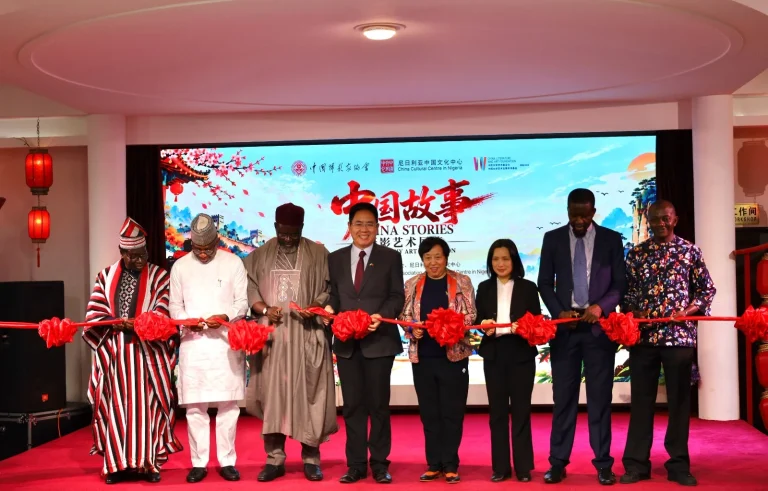
Officials from Nigeria and China say the relationship should go beyond diplomacy and trade, and they’re pointing to photography, broadcasting and digital content as ways to do it. They said so at the opening of the China Stories Photography Exhibition in Abuja on Wednesday. It was organized by the China Cultural Centre in Nigeria with the China Photographers Association, as the two countries mark 55 years of diplomatic relations. It has 40 photographs of China’s landscapes, cultural heritage and development, and drew Chinese photographers, Nigerian government officials, diplomats and people from the creative industry.
Chinese Cultural Counsellor Yang Jianxing said the show is meant to build understanding between the two countries’ artistic communities, especially photographers. “Through its unique visual language, it captures the spirit of an era, conveys human emotions and connects hearts and minds,” he said. “It serves as an important bridge for promoting mutual understanding and friendship among people from different countries.” He said the exhibition also supports the outcomes of the 2024 Beijing Summit of the Forum on China-Africa Cooperation and the Global Civilisation Initiative. Looking back over 55 years, he said the two peoples “have supported each other politically, pursued mutual benefit and win-win cooperation economically, and learned from and enriched each other culturally,” calling the relationship “a fine example of friendly exchanges among countries of the Global South.” The director of the China Cultural Centre asked cultural institutions and artists in both countries to cooperate more closely.
Abdulkarim Ibrahim, Permanent Secretary of the Federal Ministry of Arts, Culture, Tourism and Creative Economy, promised the Chinese delegation Nigeria’s support for joint exhibitions, training and other creative projects. “Photography is more than pictures. Photography is memory. It is history. It is how a nation tells its story to the world without speaking a word,” he said. He called the Chinese photographers’ visit a chance for artists on both sides to build relationships through shared creative work, and he asked for partnerships in which photographers work together, hold exhibitions and tell stories about their societies.
Charles Ebuebu, Director-General of the National Broadcasting Commission, wanted the collaboration to reach broadcasters, filmmakers, photographers and digital content creators. He linked the exhibition to the 55-year anniversary and to the 2026 China-Africa Year of People-to-People Exchanges, and said the photographs give Nigerians a view of China’s landscapes, heritage and traditions. Better broadcasting and digital technology make it easier to share cultures with the world, he said, but connection alone doesn’t create understanding. “What matters is the quality, authenticity and diversity of the stories we share,” he said.
He said exchange should go both ways and keep each country’s identity intact. “Nigerians should have opportunities to experience Chinese culture, just as Chinese audiences should have greater access to Nigeria’s rich cultural heritage, music, film, literature, festivals and creative expressions,” he said. He suggested joint documentaries, photography projects, cultural programming, exchange visits and creative industry partnerships, which he said could also boost cultural tourism, knowledge transfer and economic opportunities for creative industries. “The future of international friendship will depend not only on diplomatic engagements and economic partnerships but also on how well our peoples understand, appreciate and connect with one another,” he said. He asked the organizers to keep the initiative going and look for more cultural and media exchange opportunities.