
Nigerian hotel workers say they see things most guests never think about. Receptionists, bartenders and room attendants described drug use, coded sex parties and the unease of lodging people they suspect of crime. Their accounts, along with a Lagos sex worker’s story, a death in an Abuja hotel and a warning from the industry’s top body, show how much staff are expected to keep quiet.
A sex worker’s scare in Lekki
Patience Benita (not her real name) is a nail technician who also does part-time sex work in Lekki, Lagos. Last month, a man calling himself Ola messaged her on Facebook. After three days he moved the chat to WhatsApp and asked what she would charge. She said N200,000, and he agreed without haggling.
“He was supposed to negotiate,” she told Saturday PUNCH. “But he didn’t.” That made her suspicious, so she prepared herself before heading to the hotel he named on the Lekki-Ajah axis.
As she left, she said, she felt sharp stomach pain and blurred vision, then started vomiting near a police checkpoint. A passer-by who spoke her native language helped her call a native doctor. According to Benita, he told her over the phone that the man had tried to use her for money rituals. He gave her instructions, including water to drink as an antidote. She followed them, said the symptoms eased, and went home.
Money rituals, the belief that a person can be drained of life through voodoo to produce sudden wealth, are widely believed in parts of Nigeria. Benita said she has deleted the man’s contact and is more careful now. She also warns other women in her line of work to protect themselves.
An unsolved death in an Abuja hotel
In June last year, the body of Aladi Johnson was found in a hotel in Abuja. How she died is still unknown. The FCT Police Public Relations Officer, Josephine Adeh, said in a statement that Johnson, a woman from Benue State, checked into a hotel on Third Avenue, Gwarinpa, on June 16 with an unidentified man. He was later seen leaving without her. Hotel staff found her unconscious during routine rounds and called the police.
A receptionist who asked to be called Charles Iwunde, 30, told Saturday PUNCH that a crime like that suggests someone had spotted gaps in a hotel’s security. He pointed to a lack of compulsory ID checks for guests, or surveillance that wouldn’t capture identities. He also asked why nobody checked when staff saw the man leave alone.
Iwunde said that, in his experience, suspected internet fraudsters, commonly called Yahoo boys, lodge in hotels for weeks and bring in many women and sometimes host parties. He added that some are rude and aggressive with staff.
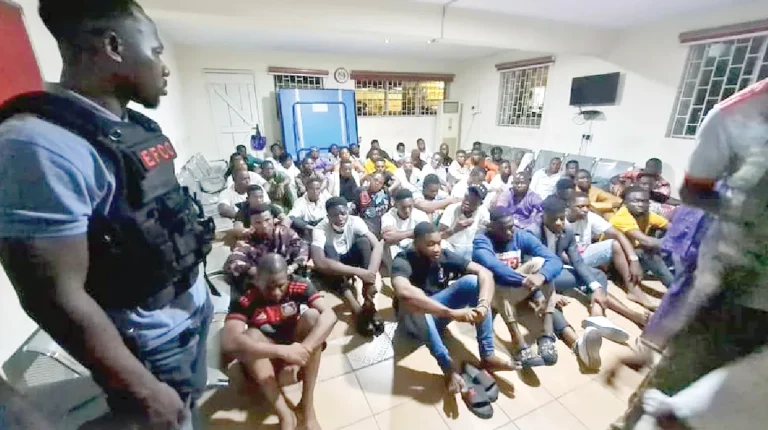
On Monday, 26 young men were reportedly arrested at a hotel in Aradagun, Olorunda Local Council Development Area, in a joint operation by soldiers and police. They were detained over alleged online business fraud and overseas employment scams. Reports say more than 100 youths, mostly aged 20 to 28, had been staying there.
What staff are told to ignore
Several workers said the job comes with a code of silence. Timileyin Asuni (not his real name), a graduate in Akure, said he worked part-time in a hotel without his parents’ knowledge. One day his father walked in with a young woman. Asuni said he stayed professional, served him and kept his composure, though he was furious inside.
Anthony Olajere, a former room service attendant, started at a four-star hotel in Ikeja in 2024 as a receptionist. He said staff aren’t allowed to speak about what they see unless it involves serious crimes, and they can’t gossip about guests or swap phone numbers with them. “Working in a hotel is like moving through a hole of secrets,” he said. Seeing so much of what goes on in rooms, he added, made him sceptical about marriage.
Olajere also said he lost his job within a year. According to him, a regular foreign-based guest he described as a Yahoo boy asked him to get cannabis, he did, and the guest paid him. Management later showed him CCTV footage of him repeatedly entering that guest’s room, and he admitted what had happened. They fired him for enabling criminal behaviour. Many guests bring illegal drugs into rooms, he said, and bribe staff who catch them.
Cannabis is illegal in Nigeria under federal laws including the Indian Hemp Act and the National Drug Law Enforcement Agency Act. Growing or trafficking it can bring severe penalties.
Underground sex parties
A bartender who gave his name as Henry said some hotels and guest houses are rented for adult sex parties, especially at weekends. After police stepped in following violent incidents at some of them, he said, many organisers have switched to short-let apartments, lounges and bars, particularly on Lagos Island.
The parties are tightly coded, he said. Locations are revealed only hours before they start. Some require passwords or particular outfits, and the venues are guarded. Where hotels are used, he claimed, there is usually an understanding between managers and organisers, with a lot of money involved.
A flier for one such party this month reached our correspondent. It asked guests to wear masks and promised games, music and drinks, with N60,000 per person payable to an account number. The location was meant to stay secret until the night, though a source close to the organisers said it was likely to be on Lagos Island. Our correspondent also saw a flier for a “Strippers Night” at a Port Harcourt hotel earlier this month, with the hotel’s address and contact details printed on it.
Authorities have acted before. In September 2022, the Anambra State Government closed a hotel in Ifite, Awka, over a viral sex party. Explicit videos reportedly circulated online, and the state said it had begun an investigation.
Fights, affairs and a church guest house
Workers say fights over lovers and bills are common. Dayo Akinfe (not his real name), a receptionist on Lagos Island, said he once moved a couple to a downstairs room where another couple was already staying. The man downstairs recognised the woman from upstairs as his fiancée, and a fight broke out. Afterwards, he said, both couples went into their rooms anyway.
Yetunde Ajao (not her real name), a hotel worker in Ibadan, said she saw her friend’s husband arrive with another woman. She broke the profession’s rules by telling her friend the room number. “It was a big fight,” she said.
Chris Udoh (not his real name) was 22 and waiting for university admission when he took a housekeeping job at his church’s guest house in Rivers State. He said the excitement faded quickly. Unmarried guests who were given separate rooms because of the house rules, he said, still left signs the next morning that they had broken them. He also described a guest who sent two younger men to a room and then repeatedly pestered him by phone. Udoh reported only that guests had brought in girls. His supervisor was angry that a church-owned guest house had been used for “unholy acts.”
William Opara, a receptionist in Lagos, said he walked in on two regular weekend guests in a compromising situation in August 2022 while going to fix a bathroom tap. One of them sent him a large sum of money and asked him to say nothing. He said he later learned they were suspected Yahoo boys.
Hotel association warns members
In April, the National President of the Nigeria Hotel Association, Patrick Anyanwu, warned members not to accommodate criminals. Any hotelier found harbouring them, including internet fraud suspects, could face sanctions, possibly closure. “Any hotelier caught harbouring criminals or ‘Yahoo Yahoo’ boys will have themselves to blame,” he said.
Hotel supervisor Biyi Ologun said hotels host people from all backgrounds, but criminals shouldn’t be given a place to hide. He urged guests to be careful about meeting strangers from social media and to tell a trusted friend or relative their location, the hotel’s name, their room number and who they are meeting. Staff who notice suspicious behaviour, he said, should report it at once to hotel security, the Nigeria Police Force or the National Agency for the Prohibition of Trafficking in Persons, and not cover it up.