
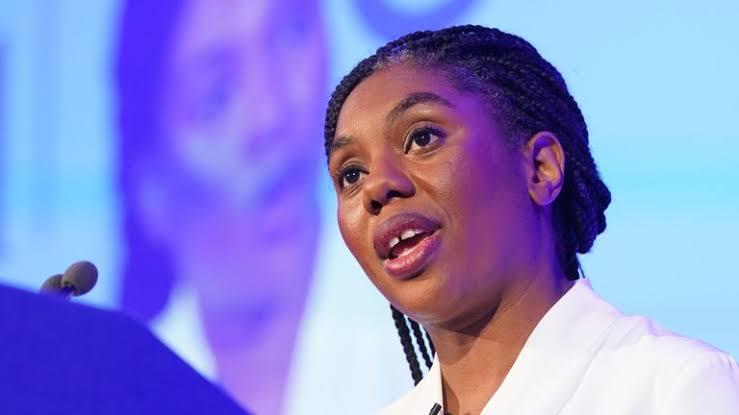
Childhood That Shaped a Political Philosophy
Kemi Badenoch did not arrive at her free-market convictions through textbooks alone. She lived them. Growing up partly in Nigeria before relocating to the United Kingdom as a teenager, Badenoch witnessed firsthand how a country sitting atop enormous oil reserves could still fail to keep the lights on for its own citizens.
Speaking in a recent interview with The Spectator, the Conservative Party leader drew on those formative experiences to make a pointed argument: natural resources, however abundant, are worthless without sound economic policy to unlock their potential.
“My belief that we need to drill our oil and gas comes from growing up in a country — Nigeria is an oil-producing country, never had electricity,” Badenoch said. “It is very easy to have resources under the ground, but stupid public policy means that you can’t use it.”
The Lesson Nigeria Teaches the World
Badenoch’s argument is not simply about Nigeria. It is about the broader relationship between government intervention and economic outcomes. Her position is that when the state overreaches — controlling, redistributing, and micromanaging industries it does not fully understand — the result is stagnation, not prosperity.
Nigeria, she suggests, is the clearest possible case study. Decades of mismanagement, corruption, and heavy-handed state control over the energy sector have left Africa’s largest oil producer with one of the world’s most unreliable power supplies. For Badenoch, that is not a coincidence. It is a consequence.
A Sharp Rebuke of UK Energy Policy
The Conservative leader did not stop at Nigeria. She used that historical lens to deliver a direct and forceful critique of Ed Miliband, the UK’s Secretary of State for Energy Security and Net Zero, comparing his policy direction to the authoritarian governance styles of Nigeria’s military administrations during the 1980s and 1990s.
“I see quite a lot of what Ed Miliband is doing as being very much like what the Nigerian military dictatorships were doing in the 80s and 90s — ‘the government is going to take control, we know what’s best, we’re going to redistribute,'” she said. “Stupid ideas which eventually just bankrupt the country.”
The comparison is deliberately provocative — and intentionally so. Badenoch is drawing a direct line between top-down state control of energy and economic decline, regardless of the ideology behind it.
A Warning Britain Cannot Afford to Ignore
Beyond energy policy, Badenoch used the interview to deliver a broader warning to British society. Having seen poverty up close, she said she carries a perspective that many lifelong residents of wealthy nations simply do not have — and she believes that perspective makes her more alert to the warning signs of decline.
“Fundamentally, my views about how we should run our country come from growing up in a place that was very poor,” she explained. “You grow up in a third-world country and you look at why it is termed ‘third world,’ and I don’t want that to happen here.”
She called on British citizens to resist complacency, urging the country to actively protect the institutions, cultural values, and economic foundations that have historically set it apart — rather than assuming those advantages will sustain themselves without careful stewardship.
The Bigger Picture
Badenoch’s remarks reflect a consistent thread running through her political identity: the belief that prosperity is never accidental, and that bad policy can squander even the richest inheritance. Whether one agrees with her conclusions or not, the Nigeria she describes — resource-rich, yet chronically underserved — is a real and sobering reality that millions of Nigerians live with every single day.
For her, that reality is not just a memory. It is a lesson she carries into every policy debate.