
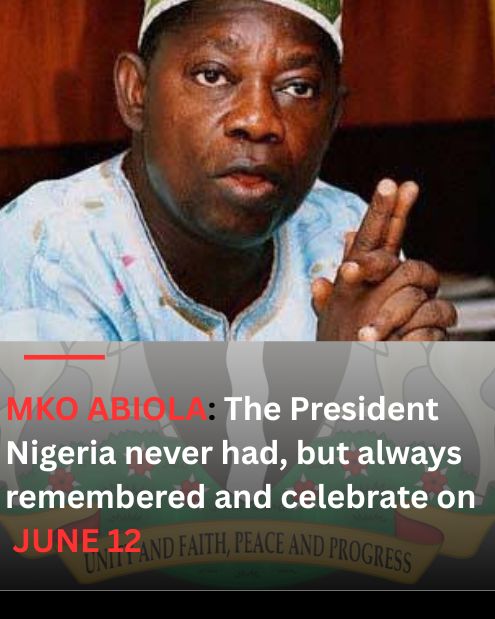
Abuja, Nigeria — June 12, 2025
Nigeria today commemorates Democracy Day, a national observance steeped in the memory of one of the most pivotal moments in the country’s political history: the annulled June 12, 1993, presidential election—widely regarded as Nigeria’s freest and fairest vote.
The day stands as a powerful tribute to Chief Moshood Kashimawo Olawale (MKO) Abiola, the presumed winner of that election, whose legacy as a symbol of democratic resistance continues to resonate across the country.
A Turning Point in Nigeria’s Democratic History
In the early 1990s, Nigeria was firmly under military rule, with General Ibrahim Babangida at the helm. After years of authoritarian governance and failed transition programs, Babangida’s regime established two government-sanctioned political parties—the Social Democratic Party (SDP) and the National Republican Convention (NRC)—in an attempt to guide the country back to civilian rule.
On June 12, 1993, Nigerians turned out in record numbers to vote in a highly anticipated presidential election. The SDP’s candidate, MKO Abiola, a wealthy Yoruba businessman and philanthropist, ran against NRC’s Alhaji Bashir Tofa of Kano State. Abiola’s campaign, notable for transcending ethnic and religious divides, garnered widespread support nationwide. Remarkably, he won even in Tofa’s home state, a sign of deep public trust.
Despite early indications of an Abiola victory, the military annulled the election on June 23, 1993, citing vague allegations of irregularities. The decision provoked widespread outrage, nationwide protests, and international condemnation. The annulment plunged Nigeria into political chaos and further entrenched military rule.
Years of Struggle and Sacrifice
Following the election’s annulment, Babangida stepped down in August 1993, handing power to an interim government led by Ernest Shonekan. This arrangement proved short-lived. By November 17, 1993, General Sani Abacha had seized control in a military coup.
The struggle for democratic restoration intensified. On June 11, 1994, MKO Abiola declared himself the rightful president of Nigeria, leading to his arrest and prolonged detention by the Abacha regime. He remained imprisoned for four years, becoming an international symbol of resistance.
Tragically, Abiola died in custody on July 7, 1998, under still-contentious circumstances—barely a month after Abacha himself had died. Abiola’s death marked the symbolic end of the June 12 struggle but also ignited fresh calls for democratic reform.
Return to Civilian Rule and National Recognition
By May 1999, Nigeria had transitioned back to civilian governance with the election of Olusegun Obasanjo as president. Initially, May 29 was designated as Democracy Day to mark the return to civilian rule.
However, in June 2018, then-President Muhammadu Buhari signed a historic executive order officially recognizing June 12 as Nigeria’s Democracy Day. The move included a posthumous award of the Grand Commander of the Federal Republic (GCFR)—the country’s highest national honour—to MKO Abiola.
Why June 12 Endures
Today, June 12 is far more than a date on the calendar. It is a symbol of the Nigerian people’s will, a reminder of the cost of freedom, and a celebration of democracy’s enduring values. It commemorates not just Abiola, but also other prominent figures in the pro-democracy movement—such as Kudirat Abiola, Gani Fawehinmi, Femi Falana, and Wole Soyinka—alongside countless ordinary citizens who risked or lost their lives.
As Nigeria continues to grapple with contemporary political challenges, the significance of June 12 as a day of reflection and resolve remains undiminished. It stands as a potent reminder that democracy, while hard-won, requires constant vigilance and the courage of those who dare to stand against tyranny.