
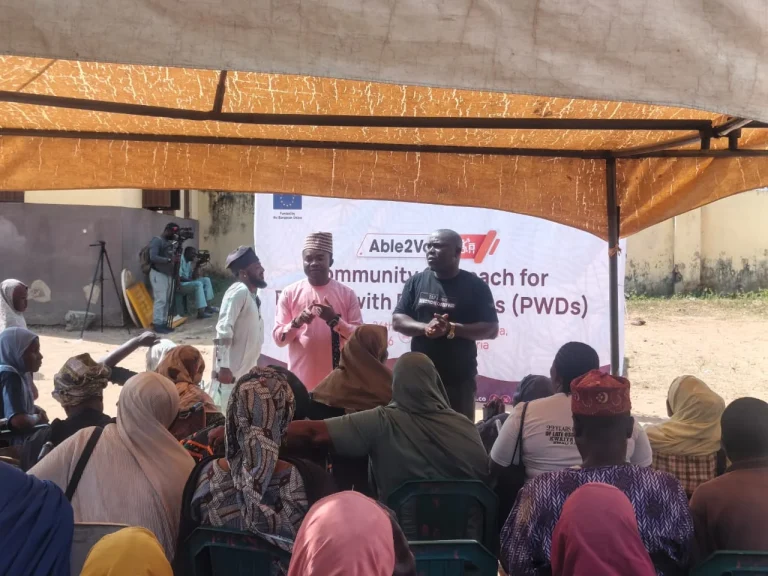
Persons with disabilities in the Federal Capital Territory have called on the Independent National Electoral Commission and security agencies to address the barriers they face at polling units ahead of the 2027 general elections.
They say poor accessibility, inadequate protection and difficulties moving around voting centres have prevented some of them from exercising their voting rights.
The concerns were raised on Thursday during a voter education campaign organised by TAF Africa in Abuja.
Speaking at the event, the leader of Persons Living with Special Needs in the FCT, Yakubu Shekolo, said wheelchair users and other persons with disabilities often struggle to access polling units and are sometimes pushed aside while trying to cast their votes.
He described the experience as frustrating, saying repeated difficulties could discourage affected voters from participating in elections.
“You see a person in a wheelchair struggling just to see how to have access to vote. And by the time you struggle, they push you; you struggle, they push you.
“You know, we get tired of everything. You just give up and say, after all, my vote is not counted,” he said.
Shekolo urged electoral authorities and other stakeholders to provide accessible voting facilities, adequate security and better protection to ensure persons with disabilities can participate fully in the 2027 elections.
He expressed hope that the sensitisation campaign would encourage more people living with disabilities to take part in the electoral process, noting that they had the constitutional right to vote and contest elections.
Earlier, the Programme Manager of TAF Africa, Andrew Adaji, said the exercise was part of the organisation’s Able2Vote voter education campaign, designed to prepare persons with disabilities for the forthcoming elections.
Adaji explained that the campaign covered voter registration, access to Permanent Voter Cards, accessible voting arrangements, ballot secrecy and peaceful participation. It also addressed how voters could identify and counter electoral misinformation.
He said TAF Africa had organised similar engagements in different parts of the country and was rounding off its activities in the FCT, with visits to communities including Kuje, Nyanya, Karu and Gwagwalada.
According to him, improved voter participation among persons with disabilities during previous off-cycle elections was partly linked to sensitisation programmes and accessibility measures introduced by INEC.
He listed Braille ballot papers, paper guides and magnifying glasses among the assistive devices provided by the electoral commission to make voting easier for persons with disabilities.
Adaji also disclosed that TAF Africa had engaged the police and the Nigeria Security and Civil Defence Corps over challenges faced by persons with disabilities during elections, particularly mobility restrictions and election-related violence.
He added that discussions were ongoing with INEC and the Sign Language Interpreters Association of Nigeria on the possibility of deploying sign language interpreters as ad hoc staff at polling units where deaf voters were expected.
Also speaking, the Secretary to the Emir of Persons with Disabilities in the FCT, Muhammad Dantani, urged political parties and their candidates to focus on improving the welfare of persons with disabilities rather than attempting to secure their support through financial inducements.
“We don’t elect parties; we elect people,” Dantani said.
He encouraged persons with disabilities to evaluate candidates based on their willingness and ability to represent their interests.
Dantani further called for ramps and other accessibility facilities in public places such as markets, hospitals and banks, arguing that inclusive infrastructure would help persons with disabilities access essential services and live with dignity.